

Focused article on the correct Misoprostol protocol to avoid treatment failure. Evidence-based · WHO 2022 guidelines · Last reviewed: June 2026
How to Take Misoprostol Correctly: The Complete Protocol to Avoid Failure
🎯 The Direct Answer
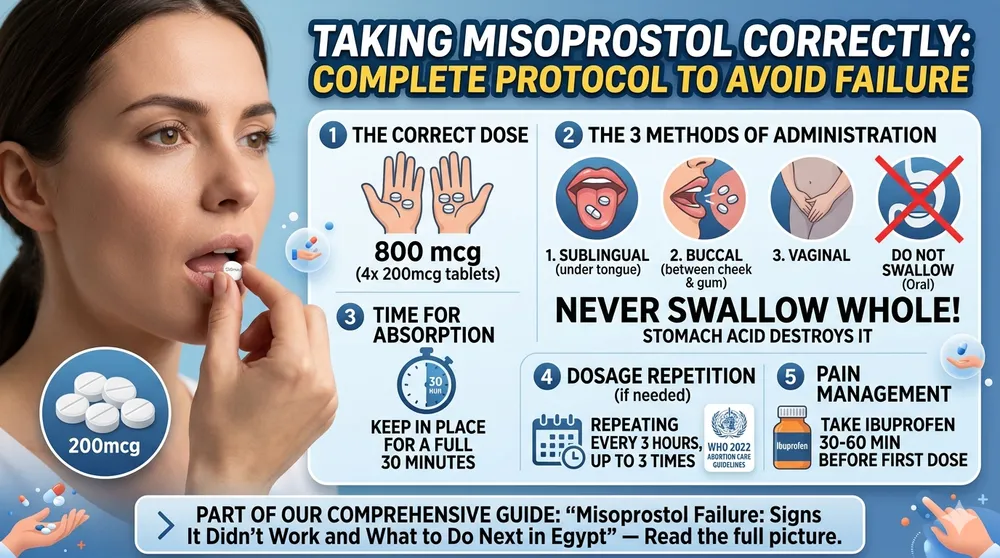
To take Misoprostol correctly and avoid failure, you must dissolve 800 mcg (4 tablets of 200 mcg each) under your tongue, between your cheek and gum, or place them vaginally — never swallow them whole with water. The tablets must stay in place for a full 30 minutes to be absorbed properly, and the dose may be repeated every 3 hours up to three times if needed, following the WHO 2022 Abortion Care Guidelines.
Misoprostol Failure: Signs It Didn’t Work and What to Do Next in Egypt — Read the complete guide for the full picture.
⚡ Key Points About Taking Misoprostol Correctly
- Never swallow Misoprostol whole — stomach acid destroys most of the active ingredient, reducing effectiveness to as low as 30–40%.
- The correct dose is 800 mcg (four tablets of 200 mcg each), and it may be repeated every 3 hours up to three times if needed.
- Keep tablets in place for a full 30 minutes — whether under your tongue, between your cheek and gum, or vaginally.
- Take ibuprofen 30–60 minutes before your first dose — it significantly reduces cramping and is the WHO-recommended pain management approach.
- The route of administration matters enormously — vaginal and sublingual routes are the most effective; oral swallowing is not recommended for abortion.
- In Egypt and MENA, Mifepristone is unavailable — following the Misoprostol-only protocol correctly is your most important tool for achieving the best possible result.

Why the Way You Take Misoprostol Matters More Than You Think
Here is something that surprises many women: two women can take the exact same Misoprostol tablets, bought from the same pharmacy, at the same gestational age — and one will have a complete result while the other will not. Often, the only difference is how they took the medication.
Misoprostol is a prostaglandin analogue — meaning it works by mimicking a natural hormone-like substance in your body that triggers uterine contractions and softens the cervix. But here is the critical point: this drug is almost completely destroyed by stomach acid when you swallow it. If you swallow Misoprostol tablets with water like a regular pill, your body absorbs only about 30 to 40% of the active ingredient. That is often not enough to complete an abortion.
To work properly, Misoprostol must be absorbed directly through the mucous membranes in your mouth or vagina — bypassing the stomach entirely. This is not a minor detail. It is the difference between a medicine that works and one that fails. The WHO 2022 Abortion Care Guidelines are clear on this: oral swallowing of Misoprostol is not recommended for medical abortion. This is the most common — and most preventable — cause of Misoprostol failure in Egypt and across the MENA region.
For a deeper understanding of what happens when Misoprostol fails and what the warning signs look like, see our comprehensive guide to Misoprostol failure. This article focuses specifically on how to take it correctly in the first place.
The Four Routes of Administration — Compared
| Route | How It’s Done | Absorption Rate | WHO Recommendation |
|---|---|---|---|
| Sublingual (under tongue) | Tablets placed under the tongue and held for 30 minutes | 80–85% | ✅ Recommended |
| Buccal (cheek) | Tablets placed between gum and cheek, held for 30 minutes | 85–90% | ✅ Recommended |
| Vaginal | Tablets inserted deep into the vagina and left in place | 90–95% | ✅ Recommended (highest efficacy) |
| Oral (swallowed) | Tablets swallowed whole with water | 30–40% | ❌ NOT recommended for abortion |
Vaginal administration gives you the highest absorption rate and the fewest systemic side effects (less nausea, less shivering). Sublingual and buccal routes are excellent alternatives with slightly more side effects but comparable effectiveness. The oral route — swallowing the tablets — is simply not effective enough and should not be used.
The Complete Step-by-Step Misoprostol Protocol
This section gives you the exact protocol, step by step. Follow it carefully. Every detail here exists for a reason.
Step 1: Prepare Your Supplies (At Least 1 Hour Before)
Before you take anything, make sure you have everything you need within reach. Running to find pain relief in the middle of heavy cramping is not a situation you want to be in.
- Ibuprofen 400–600 mg — for pain and anti-cramping (take this 30–60 minutes before the first Misoprostol dose)
- Anti-nausea medication (domperidone or metoclopramide) — take 30 minutes before Misoprostol, especially if using the sublingual route
- Thick sanitary pads (not tampons) — you will need several
- A heating pad or hot water bottle for cramping relief
- Water and light snacks for afterward
- A trusted person nearby, even if not in the same room

Step 2: Confirm Your Tablets Are Genuine
This is a step many women skip — and it can be the reason for failure. Counterfeit or substandard Misoprostol tablets are a real problem in Egypt and MENA because the medication is not always easy to obtain through official channels. Before you take anything, check:
- Tablets should come in sealed, original blister packaging
- Each tablet should be clearly labeled as 200 mcg Misoprostol
- Recognized brand names in Egypt include Misotac, Cytotec, and Fusoprost
- Tablets should not be crumbling, discolored, or smell unusual
- Check the expiry date — degraded tablets lose potency
If you are unsure about the quality of your medication, contact a trusted medical provider before proceeding. Using substandard tablets is one of the most common — and most heartbreaking — causes of Misoprostol failure we see.
Step 3: First Dose — 800 mcg (4 Tablets)
This is the most important step. Get it right.

For sublingual use (under the tongue):
- Place all 4 tablets under your tongue at the same time
- Close your mouth and keep the tablets there — do not swallow, do not spit
- Let them dissolve completely for a full 30 minutes
- After 30 minutes, swallow whatever small fragments remain with a small sip of water — this is fine and expected
- Expect shivering, chills, and nausea to begin within 30–60 minutes — this is normal and means the drug is being absorbed
For buccal use (between cheek and gum):
- Place 2 tablets between your upper left gum and cheek, and 2 tablets between your upper right gum and cheek
- Keep your mouth closed — do not chew or swallow
- Hold for a full 30 minutes while they dissolve
- After 30 minutes, swallow remaining fragments with a small sip of water
For vaginal use:
- Wash your hands thoroughly
- Lie on your back with knees bent
- Insert all 4 tablets as deep into the vagina as you can, one at a time, using your finger
- Stay lying down for at least 30 minutes after insertion
- Some light bleeding before the medication takes full effect is normal
Step 4: What to Expect in the First 6 Hours

- Hours 1–2: Shivering, chills, low-grade fever, nausea. Cramping begins — mild at first, then building. This is the medication being absorbed and taking effect.
- Hours 2–4: Contractions become stronger. Heavy bleeding begins with clots. This is the active phase — ibuprofen taken earlier should be managing the pain.
- Hours 4–6: Peak cramping and bleeding. You may pass a distinct clump of tissue — this is normal and expected.
- After 6 hours: Bleeding and cramping begin to ease. Shivering and fever resolve. You will feel tired but more comfortable.
💬 Have a Specific Question About the Misoprostol Protocol?
Get a personalized answer from Dr. Ahmad Baker. Private, encrypted consultations with medication delivery available across Egypt.
All conversations are encrypted and strictly confidential.
When and How to Repeat the Dose
The WHO 2022 protocol for the Misoprostol-only regimen allows for repeat dosing — and understanding this correctly is essential. Many women believe that taking four tablets once is the complete protocol. It is not always enough on its own.

Should You Take a Second Dose?
According to WHO guidelines, a second dose of 800 mcg can be taken 3 hours after the first dose if the response has been insufficient — meaning very little bleeding or cramping. Research consistently shows that following the full repeat-dosing protocol raises overall success rates from around 85% to approximately 93–95%. This is significant.
However, there are situations where a second dose should NOT be taken without medical guidance:
- If you have already had very heavy bleeding (soaking more than 2 thick pads per hour)
- If you have any signs of infection (fever after 24 hours, foul-smelling discharge)
- If you have any concern that the pregnancy may be outside the uterus (ectopic pregnancy)
- If you are beyond 12 weeks of pregnancy

The Full Dosing Timeline
| Timing | Action | Notes |
|---|---|---|
| T-60 minutes | Take ibuprofen 400–600 mg + anti-nausea medication | Pain management preparation |
| Hour 0 (Dose 1) | 800 mcg Misoprostol — sublingual, buccal, or vaginal | Hold in place for 30 full minutes |
| Hour 3 (Dose 2, if needed) | 800 mcg Misoprostol — same route as Dose 1 | Only if response is insufficient and no contraindications |
| Hour 6 (Dose 3, if needed) | 800 mcg Misoprostol — same route | Maximum of 3 doses per protocol cycle |
The Most Common Mistakes That Cause Misoprostol Failure
Knowing what goes wrong helps you avoid it. These are the mistakes Dr. Ahmad Baker and the Pharma Guide team see most often in women who reach out after an unsuccessful attempt.

Mistake 1: Swallowing the Tablets
This is the single most common cause of failure. Swallowing Misoprostol whole destroys most of the active ingredient in your stomach before it can reach your bloodstream. The result is either no effect or a very weak, incomplete effect. If you accidentally swallowed your tablets, contact a medical provider before deciding what to do next. Do not simply take more tablets without guidance.
Mistake 2: Not Keeping Tablets in Place Long Enough
Whether sublingual, buccal, or vaginal — the tablets need a full 30 minutes of contact with the mucous membrane to be absorbed properly. Spitting out the residue early, or getting up from lying down too soon after vaginal insertion, reduces the absorbed dose. Set a timer. Stay still. This matters.
Mistake 3: Taking Only One Dose and Waiting Days
Some women take one dose, see minimal response, and wait several days before deciding it failed. This is a mistake. If your response after the first dose is insufficient (very little bleeding, no cramping), the second dose should be taken at hour 3 — not days later. Waiting too long does not give the medication another chance; it just delays necessary follow-up care.
Mistake 4: Using Tablets From an Unverified Source
Counterfeit Misoprostol is a documented problem in regions where it is difficult to obtain legally. Tablets that look identical to genuine ones may contain little or no active ingredient. Always verify the source of your medication. If you need help accessing genuine, pharmacy-grade Misoprostol in Egypt, the Pharma Guide team can assist you privately.
Mistake 5: Not Managing Pain Properly
This one surprises people — but poor pain management can actually interfere with the process. When women experience unbearable pain without preparation, they sometimes panic, move around too much, or take additional medications (like antacids) that may interfere with absorption. Ibuprofen taken 30–60 minutes before the first dose is the best approach. It reduces cramping by blocking the same prostaglandin pathway that Misoprostol activates, making the contractions more manageable without blocking the drug’s effect on the uterus.
Mistake 6: Not Confirming the Pregnancy Is Inside the Uterus
Misoprostol only works on the uterus. If the pregnancy is located outside the uterus — called an ectopic pregnancy — Misoprostol will have no effect on it. An ectopic pregnancy is a medical emergency. If you have no bleeding at all within 24 hours of taking Misoprostol correctly, or if you experience severe one-sided pelvic pain, seek medical attention immediately. For more on this warning sign, see our full guide on Misoprostol failure signs and what they mean.
⚠️ Important Warning — Specific to Misoprostol Administration
- Do not swallow Misoprostol tablets with water — this method delivers only 30–40% of the active ingredient and is a leading cause of failure.
- Do not take a second dose if you are already soaking more than 2 thick pads per hour — this level of bleeding requires medical evaluation, not more medication.
- Do not use Misoprostol if you have not confirmed the pregnancy is inside your uterus — an undiagnosed ectopic pregnancy combined with Misoprostol use is life-threatening.
- Do not take Misoprostol with antacids at the same time — certain antacids can interfere with mucosal absorption; take them at least 2 hours apart.
- Do not stop after one tablet or half a dose — partial dosing leads to partial results, and an incomplete abortion carries serious risks if left untreated.
⚡ If you experience any of these situations, stop the medication and seek immediate medical attention at the nearest hospital.
How to Confirm the Protocol Worked
Taking Misoprostol correctly is step one. Confirming the result is equally important — and too many women skip this part, leaving themselves uncertain and at risk.

Signs That the Protocol Worked
- Heavy bleeding with visible clots and tissue in the first 4–6 hours
- Gradual reduction of bleeding over 1–2 weeks
- Pregnancy symptoms (nausea, breast tenderness, fatigue) fading within 3–7 days
- A faint or negative pregnancy test 4 weeks after taking the medication
When to Get Confirmation Testing
A home pregnancy test taken 2–4 weeks after Misoprostol is a useful screening tool. However, it is important to know that a faint positive result up to 4 weeks after a successful abortion is normal — it takes time for pregnancy hormones (hCG) to clear completely from your system. A clearly strong positive at 4 weeks or any positive at 6 weeks is concerning and should prompt medical evaluation. An ultrasound remains the gold standard — private clinics across Egypt perform these routinely without requiring explanations about the reason for the scan.
Understanding the difference between normal post-procedure bleeding and signs that something went wrong is critical at this stage. Our guide on Misoprostol failure signs covers exactly what to watch for during follow-up.
📩 Need More Help?
The Pharma Guide team, led by Dr. Ahmad Baker, is here to answer your questions. Private medical consultation and medication delivery available across Egypt.
Your privacy is our priority. All communications are confidential.
❓ Frequently Asked Questions About Taking Misoprostol Correctly
Answered by Dr. Ahmad Baker
I accidentally swallowed my Misoprostol tablets with water. What should I do now?
I vomited within 30 minutes of putting Misoprostol under my tongue. Do I need to take another dose?
Does it matter whether I use the sublingual, buccal, or vaginal route? Which is best?
I only had light bleeding and mild cramping after my first dose. Should I take a second dose immediately?
Can I eat or drink normally before taking Misoprostol?
Will a doctor or hospital be able to tell I used Misoprostol if I need medical care afterward?
How do I know if the Misoprostol tablets I have are genuine and not counterfeit?
⚠️ Important Medical Disclaimer
The information in this article is for educational and informational purposes only and does not replace professional medical advice, diagnosis, or treatment. Do not start or stop any medication without professional medical supervision. Read our full Medical Disclaimer.
📚 Related Articles on Pharma Guide
- 📖 Complete Guide: Misoprostol Failure: Signs It Didn’t Work and What to Do Next in Egypt
- Guide to Monitoring Bleeding and Symptoms During Home Medical Abortion
- Signs of Incomplete or Failed Medical Abortion — Monitoring Guide
- Medical Management of Retained Products of Conception (RPOC)
- Guide to Managing Nausea and Vomiting During Early Medical Abortion
Founder of Pharma Guide · Referral Partner for Women on Web in Egypt · 20+ years of experience
Read full bio →


Dr. Ahmad Baker, PharmD
Senior Pharmacist & Health Educator
With over 23 years of clinical experience in hospital and community pharmacy across Egypt and Saudi Arabia, Dr. Ahmad specializes in reproductive health and pharmaceutical safety. He is dedicated to providing evidence-based guidance to empower patients in the MENA region.
Medical Disclaimer: This content is for educational purposes and reflects the latest pharmaceutical protocols. It is not a substitute for personal medical advice. Always consult Dr. Ahmad Baker or your healthcare provider before starting any treatment.