

Senior Clinical Pharmacist, PharmD | Founder of Pharma Guide | Referral Partner for Women on Web in Egypt
Evidence-based guidance · WHO 2022 Abortion Care Guidelines · Last reviewed: June 2026
Misoprostol Failure: Signs It Didn’t Work, Why It Happens, and What to Do Next
📑 Complete Guide — Table of Contents
⚡ Key Facts About Misoprostol Failure
- What it is: Misoprostol failure means the medication did not completely end the pregnancy — this can mean no effect at all, or an incomplete result where some pregnancy tissue remains.
- How common is it: Using misoprostol alone (the only option in Egypt and MENA where Mifepristone is unavailable), failure rates range from approximately 10% to 15% depending on gestational age and protocol followed.
- Most critical window: If you have no bleeding within 24 hours of correct misoprostol use, this is a significant warning sign that requires attention.
- A second dose can help: According to WHO 2022 guidelines, a second dose of misoprostol can raise overall success rates to approximately 95% when the first dose does not work.
- Gestational age matters: Success rates are highest before 9 weeks of pregnancy (85–90%) and drop meaningfully after 10 weeks (75–80%).
- Incomplete abortion is the most common type of failure — meaning some tissue remains in the uterus, which requires medical attention to prevent infection.
- Follow-up is essential: An ultrasound or blood hCG test 2–4 weeks after using misoprostol is the only reliable way to confirm the abortion is complete.
- Private support is available: Dr. Ahmad Baker at Pharma Guide offers confidential consultations and medication guidance for women in Egypt and across the MENA region.
🎯 The Direct Answer
Misoprostol failure means the drug did not work as expected to end the pregnancy — and it can be identified by specific warning signs including no bleeding within 24 hours, continuing pregnancy symptoms after one week, or a still-positive pregnancy test four weeks later.
In Egypt and across the MENA region, Mifepristone — the more effective partner drug — is simply not available. This means women here rely entirely on the misoprostol-only protocol, which is a WHO-approved and well-studied method. When used correctly, it works in 85 to 90% of cases in early pregnancy. But in roughly 1 in 10 cases, the medication does not fully work. This is not a rare or shameful outcome — it is a medically recognized possibility that has clear solutions.
Misoprostol failure can take different forms. In some cases, the pregnancy continues (called a continuing pregnancy). In other cases, the abortion starts but does not complete — meaning some pregnancy tissue remains in the uterus (called an incomplete abortion). Both situations require medical follow-up. The good news is that a second dose of misoprostol, taken correctly, resolves many incomplete cases. When medication alone is not enough, safe surgical options are also available. The most important thing is to recognize the signs early and take action — which is exactly what this guide helps you do.
1. What Is Misoprostol Failure? Definition and Medical Context

Misoprostol failure refers to any outcome in which the medication does not successfully and completely terminate a pregnancy. In medical terms, there are two distinct types of failure that doctors and pharmacists recognize:
Continuing Pregnancy (Complete Failure)
This is the less common type, where the pregnancy continues to develop despite taking misoprostol. The embryo or fetus is still alive and growing. This happens in approximately 2 to 5% of misoprostol-only cases. It is important to understand that if the pregnancy continues, it does not automatically mean the baby will have birth defects — but misoprostol exposure does carry some risk of fetal abnormalities, particularly if taken in the first trimester. This is one of the reasons why medical follow-up is so important.
Incomplete Abortion (Partial Failure)
This is the more common type of failure. Here, the pregnancy does end — meaning the embryo or fetus is no longer alive — but not all of the pregnancy tissue leaves the uterus. Some tissue (called retained products of conception) remains inside. This situation requires further treatment, either with a second dose of medication or a minor surgical procedure, because retained tissue can cause serious infections if left untreated.
Why This Matters in Egypt and MENA
In countries like Egypt, Jordan, Saudi Arabia, and other MENA nations, Mifepristone — the drug that is usually combined with misoprostol in the gold-standard two-drug protocol — is not available. The combination of Mifepristone and Misoprostol has a success rate of 95 to 98%. The misoprostol-only protocol, which is what women in this region must use, has a lower but still substantial success rate of 85 to 90% in early pregnancy. This is a WHO-approved protocol, not a second-rate workaround. But it does mean that misoprostol failure is somewhat more common here than in countries where the combination regimen is used. This guide exists specifically to help you understand, identify, and manage that possibility safely.
Understanding that failure is a medical outcome — not a personal failure, not a punishment, not a reason for shame — is the first and most important step. Millions of women around the world have experienced misoprostol failure and have gone on to receive safe, effective follow-up care.
2. How Misoprostol Works to End a Pregnancy

To understand why misoprostol sometimes fails, it helps to first understand exactly how it works when it succeeds. Misoprostol is a prostaglandin E1 analogue — meaning it mimics a natural hormone-like substance that the body produces called prostaglandin. Prostaglandins are involved in many bodily processes, including inflammation, pain, and — crucially — uterine contractions.
The Three Main Actions of Misoprostol
- Cervical softening and opening (dilation): Misoprostol causes the cervix — the lower opening of the uterus — to soften, thin, and open slightly. This makes it physically possible for pregnancy tissue to pass through.
- Uterine contractions: The drug stimulates the muscle wall of the uterus (called the myometrium) to contract. These contractions are what cause cramping and what physically push the pregnancy tissue out of the uterus.
- Endometrial effects: Misoprostol also affects the lining of the uterus in ways that make it less supportive of an ongoing pregnancy.
Routes of Administration and How They Affect Efficacy
How you take misoprostol significantly affects how well it works. The WHO 2022 Abortion Care Guidelines recognize several administration routes, each with different absorption rates and side effect profiles. Understanding this is important because incorrect administration is one of the most common — and most preventable — reasons for misoprostol failure.
| Route | How It’s Used | Absorption Rate | Notes |
|---|---|---|---|
| Vaginal | Tablets placed deep in the vagina | Highest (90–95%) | Most effective; fewer systemic side effects |
| Buccal (cheek) | Tablets dissolved between gum and cheek | High (85–90%) | Good alternative; tablets must dissolve fully (30 min) |
| Sublingual (under tongue) | Tablets dissolved under the tongue | High (80–85%) | Fast onset; more nausea and shivering |
| Oral (swallowed) | Tablets swallowed whole with water | Low (30–40%) | NOT recommended for abortion — too low efficacy |
This last point is critically important: swallowing misoprostol tablets whole is one of the most common causes of treatment failure. The drug is broken down by stomach acid before it can be absorbed properly. It must dissolve in the mouth (buccal or sublingual) or be absorbed vaginally. Many women in Egypt who receive misoprostol without proper instructions make this mistake and then wonder why it did not work. If you are unsure about the correct method, please reach out before taking the medication.
3. Who Is More Likely to Experience Misoprostol Failure?

Misoprostol failure does not happen randomly. There are specific risk factors that make some women more likely to experience incomplete or failed abortion. Understanding these factors helps you know whether you may need extra medical support, and helps explain why failure happened if it did.
Higher Gestational Age
This is the single biggest factor affecting misoprostol success. The further along the pregnancy is, the less effective misoprostol alone becomes. At 4 to 6 weeks, success rates are around 90 to 95%. At 7 to 9 weeks, they drop to 85 to 90%. At 10 to 12 weeks, the risk of incomplete abortion increases significantly, with success rates falling to roughly 75 to 80%. After 12 weeks, the misoprostol-only protocol for abortion is generally not recommended without direct medical supervision, and surgical intervention is often safer and more effective.
Incorrect Administration
As discussed above, swallowing the tablets rather than dissolving them in the mouth or placing them vaginally dramatically reduces efficacy. Similarly, not keeping buccal or sublingual tablets in place for the full 30 minutes, or using too low a dose, can cause failure. The correct WHO-recommended dose for the misoprostol-only protocol is 800 micrograms (mcg), typically four tablets of 200 mcg each, repeated every 3 hours if needed.
Substandard or Counterfeit Medication
This is a serious concern in Egypt and across MENA. Because misoprostol is a controlled medication, it is sometimes obtained through informal channels. Counterfeit or substandard tablets may contain the wrong dose, degraded active ingredient, or no active ingredient at all. Tablets should always come in original blister packaging from a reputable brand such as Misotac, Cytotec, or Fusoprost.
Uterine Abnormalities
Structural issues with the uterus — such as fibroids (non-cancerous growths in the uterine muscle), an unusually shaped uterus, or significant scarring from previous surgeries — can make it harder for the uterus to contract effectively and expel pregnancy tissue.
Previous Cesarean Section (C-section)
Women who have had a previous C-section have scar tissue on the uterus. This can affect how the uterine muscle responds to misoprostol. Research published in the journal Contraception found that women with previous C-sections had a failure rate approximately 15% higher than women who had vaginal deliveries.
Drug Interactions
Certain medications can reduce misoprostol’s effectiveness. These include progesterone supplements (often used in fertility treatments), some hormonal contraceptives, and certain antacids. If you are taking any medications regularly, this is something to discuss with a healthcare provider before using misoprostol.
💬 Not Sure If This Is Right for You?
Dr. Ahmad Baker provides private, confidential medical consultations to help you understand your options. Medication delivery is also available across Egypt.
All conversations are encrypted and strictly confidential.
4. Why Does Misoprostol Fail? Six Common Reasons

Knowing exactly why misoprostol sometimes fails is empowering. It helps you identify what may have gone wrong in your specific situation, it helps you avoid mistakes in the future, and it reassures you that failure is usually explainable — not mysterious or random. Here are the six most common reasons, based on WHO guidelines and published clinical research.
Reason 1: Incorrect Administration Method
We touched on this above, but it deserves its own section because it is the most preventable cause of failure. Misoprostol must reach the bloodstream efficiently. Swallowing it whole destroys most of the active ingredient in the stomach. The tablet must be dissolved under the tongue (sublingual), held between the cheek and gum (buccal), or inserted into the vagina. Each of these methods allows direct absorption into the bloodstream through the mucous membranes, bypassing stomach acid entirely. If you took misoprostol by swallowing it, this is very likely why it did not work or worked only partially.
Reason 2: Insufficient Dose or Incomplete Protocol
Some women take only one dose and wait, when the WHO-recommended protocol for misoprostol-only abortion calls for 800 mcg (4 tablets of 200 mcg each), which may be repeated every 3 hours up to three times if needed. Taking just four tablets and not repeating the dose when there is insufficient response is a common reason for incomplete results. The full protocol matters.
Reason 3: Counterfeit or Degraded Tablets
In markets where misoprostol is difficult to obtain legally, counterfeit products are unfortunately common. A genuine tablet of misoprostol should come sealed in branded blister packaging (Misotac, Cytotec, Fusoprost), clearly labeled at 200 mcg per tablet. Tablets stored in heat or humidity can also degrade over time, losing potency. If you obtained tablets through an unverified source, this may be the cause of failure.
Reason 4: Pregnancy Too Advanced
If the pregnancy is further along than estimated — particularly beyond 9 weeks — the misoprostol-only protocol becomes significantly less effective. This is because a larger and more developed pregnancy requires stronger and more sustained uterine contractions to expel. If your gestational age was calculated incorrectly (which can happen without an ultrasound), you may have used misoprostol at a stage where it was insufficient.
Reason 5: Biological Variability and Uterine Factors
Every woman’s body responds slightly differently to medications. Some women have uteruses that are less responsive to prostaglandins for reasons that are not fully understood. Uterine fibroids, a bicornuate (heart-shaped) uterus, or other anatomical variations can physically prevent complete expulsion of pregnancy tissue even when the drug is absorbed correctly and the uterus is contracting.
Reason 6: Ectopic Pregnancy
This is a rare but critically important cause of “failure.” An ectopic pregnancy — where the embryo implants outside the uterus, usually in a fallopian tube — cannot be treated with misoprostol at all. Misoprostol acts on the uterus, not on ectopic implantation sites. If you have an ectopic pregnancy and take misoprostol, you will not have the typical heavy bleeding of a uterine abortion. Instead, the ectopic pregnancy continues to grow and can rupture the fallopian tube, causing life-threatening internal bleeding. This is one of the most important reasons why a confirmed intrauterine pregnancy (ideally via ultrasound) should be established before using misoprostol.
5. Signs and Symptoms That Misoprostol Did Not Work

One of the most stressful parts of misoprostol failure is uncertainty — not knowing whether the treatment worked or not. This section gives you specific, clear signs to watch for. Remember: you cannot rely on how you feel alone to determine success. Some of the signs below require confirmation with a test or clinical examination.
Sign 1: No Bleeding Within 24 Hours
When misoprostol works correctly, significant uterine bleeding — heavier than a normal period, usually with visible clots — should begin within 1 to 4 hours of taking the medication, and almost always within 24 hours. If you have had absolutely no bleeding, or only very light spotting, 24 hours after correctly administering misoprostol, this is a strong indicator that the drug either was not absorbed properly or is not working for your body. This does not automatically mean a complete failure — it may mean a second dose is needed — but it requires attention.
Sign 2: Bleeding Stops Very Quickly Without Passing Tissue
Some women experience initial bleeding that stops after just a few hours without passing any visible clots or tissue. While some variation in bleeding is normal, very brief bleeding (less than 2 to 3 days) followed by complete stopping, without having passed any recognizable tissue or clots, may indicate incomplete abortion. The bleeding should generally last 1 to 3 weeks, though it naturally tapers over time.
Sign 3: Continuing Pregnancy Symptoms After One Week
Common early pregnancy symptoms — including breast tenderness, nausea, fatigue, and food aversions — should begin to ease and disappear as pregnancy hormone (hCG) levels drop after a successful abortion. If these symptoms are still clearly present one week after taking misoprostol, this may indicate that the pregnancy is continuing. Note that some mild symptoms can persist for up to two weeks even after successful abortion due to lingering hormones, but significant ongoing symptoms deserve medical evaluation.
Sign 4: Positive Pregnancy Test 4 or More Weeks Later
This is one of the most reliable home indicators of failure. After a successful abortion, hCG levels drop steadily. Most home pregnancy tests will still show a faint positive result for 2 to 4 weeks after a complete abortion because it takes time for hormones to clear. However, a clearly strong positive pregnancy test at the 4-week mark, or any positive test at the 6-week mark, strongly suggests the pregnancy is continuing or there are retained products of conception still producing hormones.
Sign 5: Severe or Increasing Pain That Does Not Improve
Significant cramping during the first 6 to 12 hours after misoprostol is expected and normal — this is the uterus contracting. However, if severe abdominal pain does not improve after 12 to 24 hours, or if the pain is getting worse over the following days rather than better, this may indicate retained pregnancy tissue, infection, or in rare cases, an ectopic pregnancy.
Sign 6: Fever Lasting More Than 24 Hours
A low-grade fever (up to 38°C or 100.4°F) in the first few hours after taking misoprostol is a known and common side effect of the medication itself — it is caused by the prostaglandins. This is not a sign of failure or infection. However, if fever develops more than 24 hours after taking misoprostol, or if any fever lasts longer than 24 hours, or if you develop fever, chills, and foul-smelling discharge together, these signs point to infection, which can occur with retained products of conception after incomplete abortion.
Sign 7: Ultrasound Showing Gestational Sac Still Present
An ultrasound examination 2 to 4 weeks after taking misoprostol is the most definitive way to confirm whether the abortion is complete. If the ultrasound shows a gestational sac (the fluid-filled structure that surrounds the embryo) that is still intact, or significant retained pregnancy tissue, this confirms that misoprostol did not fully work.
6. What to Expect When Misoprostol IS Working (Normal Timeline)

To recognize failure, you first need to know what success looks like. Here is a detailed, hour-by-hour and day-by-day guide to the normal experience when misoprostol is working as expected.
Hours 1 to 3: Medication Absorption and Early Response
During this time, misoprostol is being absorbed through the mucous membranes. Side effects begin to appear: chills and shivering (very common with sublingual and buccal routes), low-grade fever, nausea, and sometimes vomiting or diarrhea. These systemic side effects are caused by the prostaglandins entering your bloodstream and are signs the drug is being absorbed — not signs something is wrong. Cramping usually begins within 1 to 2 hours, starting mild and building in intensity. Light bleeding or spotting may begin.
Hours 3 to 6: Peak Contractions and Heavy Bleeding
This is typically the most intense phase. Uterine contractions are at their strongest. Bleeding becomes heavy — heavier than a normal period — and you will likely pass large clots and, at some point, the pregnancy tissue itself. Many women describe this as the most painful part, comparable to labor contractions. Pain medication (ibuprofen is recommended, as it also helps reduce uterine cramping) should be taken in advance. Passing a distinct, dense clump of tissue — sometimes grayish or pinkish — among the blood clots is a sign that the pregnancy has been expelled. The shivering and fever usually begin to ease during this period.
Hours 6 to 24: Tapering and Stabilization
Bleeding typically begins to slow from the very heavy flow of the peak phase, though it remains heavier than a normal period. Cramping reduces significantly. Side effects like nausea and chills resolve in most women. Energy levels slowly begin to return. You should be able to rest comfortably.
Days 2 to 14: Continued Light Bleeding and Recovery
Bleeding continues at a lighter level — similar to a medium-flow period — for approximately 1 to 2 weeks. This is normal. Spotting may continue for up to 4 weeks in some women. Pregnancy symptoms (nausea, breast tenderness) should begin fading noticeably by day 3 to 5 and be largely gone by the end of the first week. Your next menstrual period will typically return 4 to 6 weeks after the abortion.
7. Misoprostol Success Rates by Gestational Age

The effectiveness of misoprostol is not the same at every stage of pregnancy. This is one of the most important facts to understand. The WHO 2022 Abortion Care Guidelines, along with large-scale clinical studies from Ipas and FIGO (the International Federation of Gynecology and Obstetrics), provide the following effectiveness data for the misoprostol-only protocol:
| Gestational Age | Success Rate (Misoprostol-Only) | Risk of Incomplete Abortion |
|---|---|---|
| Up to 6 weeks | 90–95% | Low (5–10%) |
| 7 to 9 weeks | 85–90% | Moderate (10–15%) |
| 10 to 12 weeks | 75–80% | Higher (20–25%) |
| After 12 weeks | Variable / Lower | High — requires medical supervision |
What does “success” mean in these statistics? A successful misoprostol abortion means complete expulsion of all pregnancy tissue from the uterus without the need for any additional surgical intervention. “Incomplete abortion” means the drug initiated the process but did not finish it — some tissue remains. “Continuing pregnancy” means the drug had no meaningful effect and the pregnancy is still developing.
For comparison, the Mifepristone + Misoprostol combination (unavailable in Egypt and MENA) achieves success rates of 95 to 98% across all gestational ages up to 12 weeks. This is why — if you have a choice about timing — using misoprostol as early in the pregnancy as possible gives you the best chance of a complete result with the misoprostol-only protocol available in this region.
8. What to Do If Misoprostol Did Not Work — Your Next Steps
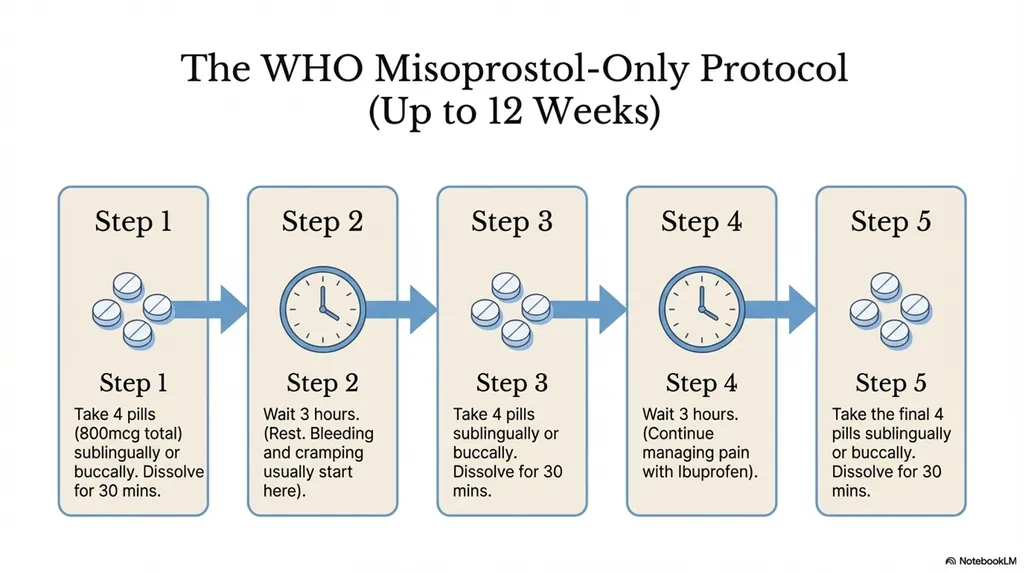
If you believe misoprostol did not work — either based on the signs described above, or because you have had no bleeding — here is a clear, step-by-step guide to what you should do.
Step 1: Do Not Panic — But Do Not Wait Too Long
Misoprostol failure is a manageable medical situation when addressed promptly. The most important thing is to take action within a reasonable timeframe — days, not weeks. Waiting too long with retained pregnancy tissue significantly increases the risk of infection, which can become serious.
Step 2: Consider a Second Dose (If Appropriate)
According to WHO 2022 guidelines, if the first dose of misoprostol causes no or very little response (no significant bleeding, no tissue passage), a second dose of 800 mcg can be taken 24 to 48 hours after the first. This is done using the same route of administration — vaginal, buccal, or sublingual. Clinical data from multiple studies shows that a second dose raises the overall success rate of the misoprostol-only protocol to approximately 93 to 95%. However, a second dose should only be considered if:
- You have no signs of infection (no fever lasting more than 24 hours, no foul-smelling discharge)
- You are not experiencing severe pain
- The pregnancy is confirmed to be intrauterine (inside the uterus — not ectopic)
- You are still within an appropriate gestational age range
Step 3: Confirm with a Pregnancy Test or Ultrasound
Two to four weeks after taking misoprostol, take a home pregnancy test. If it is clearly positive (dark line, not faint), contact a healthcare provider. Even better — if you can access it safely and privately — an ultrasound provides definitive information about whether pregnancy tissue remains in the uterus. In Egypt, private ultrasound clinics are widely available and do not typically ask about the cause of any bleeding or irregularity you might report.
Step 4: Surgical Options If Needed
If misoprostol has not worked and a second dose is not appropriate, or if a second dose also fails, surgical options are safe, effective, and not uncommon. The two main procedures are:
- Manual Vacuum Aspiration (MVA): A gentle suction procedure that removes remaining pregnancy tissue from the uterus. It takes approximately 5 to 10 minutes and is highly effective. It can be done under local anesthesia in an outpatient setting. The WHO considers this the safest and preferred surgical method for early pregnancy.
- Dilation and Curettage (D&C): A more comprehensive surgical procedure that involves widening the cervix and removing tissue with a surgical instrument. It is typically performed in a hospital or clinic setting. It may be recommended for more advanced incomplete abortions or when infection is present.
Seeking surgical help for a failed medical abortion is a completely valid and medically appropriate step. It does not mean you did anything wrong. The WHO specifically recognizes surgical completion as a standard part of the abortion care pathway when medication alone is insufficient.
Step 5: Get Support — You Should Not Navigate This Alone
If you are in Egypt and are facing misoprostol failure, Dr. Ahmad Baker and the Pharma Guide team can help you privately understand your options, confirm what may have gone wrong, and access appropriate next steps — including referrals to trusted medical facilities. All consultations are strictly confidential.
9. Side Effects vs. Failure Signs: How to Tell the Difference

One of the most confusing aspects of misoprostol use is knowing which symptoms are expected side effects of the medication versus which symptoms indicate something is wrong. Here is a clear breakdown.
Normal Side Effects (Signs the Drug Is Working)
- Chills and shivering: Very common, especially with sublingual and buccal use. Typically begins within 30 to 60 minutes and resolves within 3 hours.
- Low-grade fever (up to 38°C / 100.4°F): Normal in the first 6 hours. This is a prostaglandin effect, not an infection.
- Nausea and vomiting: Common, especially sublingually. Taking an anti-nausea medication (like domperidone or metoclopramide) 30 minutes before misoprostol helps significantly.
- Diarrhea: Common in the first few hours. Drink fluids to stay hydrated.
- Heavy cramping: Expected and normal. Take ibuprofen 400–600 mg regularly (every 6–8 hours) for best pain control. A heating pad also helps.
- Heavy bleeding with clots: Normal and expected — this is what should happen.
- Headache: Common. Mild and manageable with paracetamol (acetaminophen).
Concerning Signs That Require Medical Attention
- Fever above 38°C lasting more than 24 hours — this is beyond the normal prostaglandin effect and suggests possible infection.
- No bleeding at all within 24 hours — possible failure or ectopic pregnancy.
- Soaking more than 2 thick pads per hour for 2 or more consecutive hours — excessive bleeding requiring emergency care.
- Foul-smelling vaginal discharge — sign of infection.
- Severe pain not responding to ibuprofen — especially if it worsens rather than improves after the first 12 hours.
- Dizziness, faintness, or rapid heartbeat — possible signs of significant blood loss.
10. Risks of Untreated Misoprostol Failure

It is important to be honest about the risks of leaving misoprostol failure untreated. We share this information not to frighten you, but because understanding these risks helps explain why prompt action matters so much. The good news is that all of these complications are preventable with timely follow-up care.
Infection (Endometritis or Sepsis)
Retained pregnancy tissue in the uterus creates an environment where bacteria can grow rapidly. This can cause endometritis — infection of the uterine lining — which causes fever, abdominal pain, and foul-smelling discharge. If untreated, endometritis can progress to sepsis, a life-threatening body-wide infection. Research published in the journal Obstetrics and Gynecology found that women who delay seeking care for incomplete abortion are three times more likely to develop serious infection compared to those who seek timely help.
Hemorrhage (Excessive Bleeding)
Retained tissue can interfere with the uterus’s ability to contract fully after the pregnancy ends. The uterus contracts primarily to close off blood vessels — when it cannot contract properly due to remaining tissue, bleeding continues and can become excessive. Hemorrhage after medical abortion, while rare, is a medical emergency.
Continuing Pregnancy Complications
If the pregnancy is actually continuing — a complete failure — and it goes undetected for several more weeks, the pregnancy will eventually advance to a stage where it cannot be managed with medication at all. More invasive intervention will then be required. Additionally, the fetus will have been exposed to misoprostol during a critical developmental window, which carries a small but real risk of certain birth defects.
Psychological Impact
The uncertainty and waiting that accompanies a possible misoprostol failure is genuinely distressing. Many women describe feeling anxious, isolated, and unsure of what to do. This is a completely valid emotional response to a frightening situation. Seeking clear medical information and private support — through a trusted provider like Pharma Guide — can significantly reduce this burden. You should not have to navigate this alone.
🚨 Warning Signs — Seek Emergency Medical Help Immediately If:
- You are soaking more than 2 thick sanitary pads per hour for 2 or more hours in a row — this indicates dangerous levels of blood loss.
- You have a fever above 38°C (100.4°F) that develops after the first 24 hours or that lasts more than 24 hours — this is a sign of possible infection, not a normal medication side effect.
- You have severe abdominal or pelvic pain that is not relieved by ibuprofen or other pain medications — especially if the pain is on one side, which could indicate an ectopic pregnancy.
- You notice foul-smelling vaginal discharge or discharge with an unusual color (greenish or grayish) — these are signs of infection that can become serious.
- You have had absolutely no bleeding at all within 24 hours of taking misoprostol correctly — this requires urgent evaluation to rule out ectopic pregnancy and complete failure.
- You feel faint, dizzy, or notice your heart beating very fast or irregularly — these can be signs of significant blood loss requiring immediate treatment.
- You develop difficulty breathing, swelling of the face, lips, or throat, or a widespread rash — these are signs of a rare but serious allergic reaction requiring emergency care immediately.
⚠️ Do not hesitate. These signs require immediate in-person medical attention at the nearest hospital or emergency room. You can report any of these symptoms to a doctor as “heavy menstrual bleeding” or “miscarriage symptoms” if you prefer not to disclose the use of medication — the medical treatment required is identical.
🩺 Need Medical Guidance Right Now?
If you’re experiencing any of the above symptoms — or if you simply have questions about whether your treatment worked — reach out to Dr. Ahmad Baker for immediate, private support. Medication consultation and delivery available across Egypt.
❓ Frequently Asked Questions About Misoprostol Failure
Answered by Dr. Ahmad Baker, Senior Clinical Pharmacist
How do I know if misoprostol worked or failed?
Can I take a second dose of misoprostol if the first one didn’t work?
Is misoprostol available in Egypt, and can I get genuine tablets?
I had some bleeding but it stopped after one day. Did misoprostol work?
What happens if I just wait and do nothing after a failed misoprostol attempt?
Will a doctor at a hospital be able to tell I used misoprostol?
Does misoprostol failure affect my ability to get pregnant in the future?
I took misoprostol incorrectly (swallowed it). What should I do now?
How long after taking misoprostol should I wait before concluding it failed?
Is there anything I can do to increase my chances of misoprostol working?
📩 Have a Question About This Topic?
The Pharma Guide medical team, led by Dr. Ahmad Baker, is ready to answer all your questions about misoprostol failure, incomplete abortion, and your safest next steps. Private consultations and medication delivery available across Egypt.
Your privacy is our priority. All communications are encrypted and confidential.
⚠️ Important Medical Disclaimer
The information in this article is provided for educational and informational purposes only and does not replace professional medical advice, diagnosis, or treatment. Misoprostol is a prescription-level medication with significant physiological effects. Always consult a qualified healthcare provider before making any medical decisions related to pregnancy management. For our full disclaimer, please read our Medical Disclaimer page.
📚 Read Also on Pharma Guide
- Bleeding Duration and Recovery After Using Misotac (Misoprostol)
- Misotac Guide: Uses of Misoprostol in Reproductive Health
- Can Doctors Detect Abortion Pills? A Guide to Privacy and Safe Medical Consultation
- Menstrual Cycle Recovery Timeline Post-Medical Abortion
- Guide to Understanding Endometrial Thickness After Medical Abortion
- Mifepristone: Regional Availability and Clinical Context Overview
- Misotac Tablets and Their Impact on Pregnancy and Future Fertility
- Misoprostol Guide: Comparing Cytotec, Misotac, and Fusoprost
About Dr. Ahmad Baker
Dr. Ahmad Baker is a Senior Clinical Pharmacist (PharmD) with over 20 years of experience in Egypt and Saudi Arabia. He is the founder of Pharma Guide and a referral partner for Women on Web in Egypt, dedicated to providing safe, evidence-based reproductive health information and medication access to women across the MENA region. His guidance is rooted in WHO 2022 Abortion Care Guidelines and current clinical evidence.
Read full bio →


Dr. Ahmad Baker, PharmD
Senior Pharmacist & Health Educator
With over 23 years of clinical experience in hospital and community pharmacy across Egypt and Saudi Arabia, Dr. Ahmad specializes in reproductive health and pharmaceutical safety. He is dedicated to providing evidence-based guidance to empower patients in the MENA region.
Medical Disclaimer: This content is for educational purposes and reflects the latest pharmaceutical protocols. It is not a substitute for personal medical advice. Always consult Dr. Ahmad Baker or your healthcare provider before starting any treatment.