
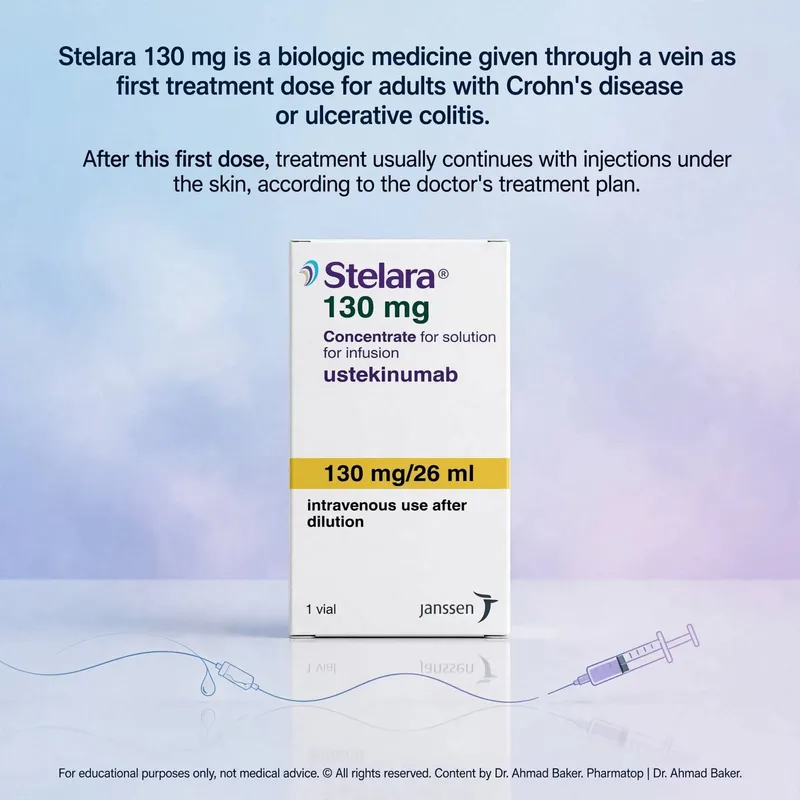
Stelara 130 mg IV Infusion (Ustekinumab): Complete Clinical Guide to Induction Dosing, Preparation Protocols & Safety Monitoring
Stelara 130 mg concentrate for solution for infusion is a weight-based intravenous biologic induction therapy containing ustekinumab, a fully human monoclonal antibody that selectively neutralises the shared p40 subunit of interleukin-12 and interleukin-23. Administered as a single hospital-based loading dose for adults with moderately-to-severely active Crohn’s disease or ulcerative colitis, this IV formulation rapidly saturates target cytokine receptors to achieve mucosal healing before patients transition to long-term subcutaneous maintenance dosing.
📑 Table of Contents
[Insert Stelara 130 mg IV Vial Product Image Here]
⚡ Clinical Quick Facts: Stelara 130 mg IV
| 📦 Generic & Brand Names | Ustekinumab / Stelara® 130 mg Concentrate for Infusion |
| 🔬 Active Molecule(s) | Ustekinumab 130 mg (5 mg/mL) – fully human IgG1κ monoclonal antibody |
| 💊 Dosage Form & Strength | Single-use glass vial containing 26 mL sterile concentrate for IV dilution |
| 🏭 Manufacturer | Janssen-Cilag (Johnson & Johnson Group) |
| 🌍 Origin / Distribution | Belgium / Switzerland – distributed across MENA via authorised regional agents |
| 📋 Regulatory Classification | Rx Only – Specialist-Initiated Biologic (Gastroenterology / Immunology) |
| 📏 Standard Adult Dosage | Weight-tiered single IV infusion (~6 mg/kg): 260 mg, 390 mg, or 520 mg |
| 📌 Prescription Required? | Yes – restricted to hospital day-unit settings under consultant supervision |
| 🏷️ Estimated Regional Cost | ~53,000 EGP per vial (Egypt) – varies by market; insurance pre-authorisation typically required |
1. What is Stelara 130 mg IV (Ustekinumab Intravenous)?
Stelara represents one of the most significant advances in targeted immunomodulatory therapy for inflammatory bowel disease (IBD) over the past decade. Its active pharmaceutical ingredient, ustekinumab, is a fully human immunoglobulin G1 kappa (IgG1κ) monoclonal antibody produced through recombinant DNA technology in a murine myeloma cell line (Sp2/0). Unlike conventional broad-spectrum immunosuppressants that blunt the entire immune response, ustekinumab operates with remarkable precision by binding exclusively to the p40 protein subunit shared by two pro-inflammatory cytokines: interleukin-12 (IL-12) and interleukin-23 (IL-23).
It is critically important for clinicians and patients alike to understand that Stelara is available in two fundamentally distinct pharmaceutical presentations, each serving a different phase of the treatment pathway:
- Stelara 130 mg / 26 mL IV Concentrate (the focus of this guide): This single-use vial contains a concentrated solution that must be diluted in normal saline and administered exclusively via intravenous infusion in a hospital or accredited day-care unit. It is never injected subcutaneously. The IV formulation serves as the one-time induction loading dose designed to rapidly achieve therapeutic serum concentrations, overwhelm the inflammatory cytokine cascade, and initiate mucosal healing in the gastrointestinal tract of patients with active Crohn’s disease or ulcerative colitis.
- Stelara Pre-filled Syringes (45 mg and 90 mg SC): These ready-to-use subcutaneous injections serve dual purposes. In dermatology and rheumatology, they are used from the outset for plaque psoriasis and psoriatic arthritis. In gastroenterology, they become the long-term maintenance therapy that patients self-administer at home every 8 or 12 weeks following completion of the initial IV induction dose.
Manufactured by Janssen Biotech, a subsidiary of Johnson & Johnson, Stelara holds marketing authorisations from the US FDA, the European Medicines Agency (EMA), and multiple national regulatory authorities across the Middle East and North Africa. For a comprehensive overview of biologic therapies available in the region, visit the Pharma Guide Drug Index.
2. Detailed Composition & Mechanism of Action
Each Stelara 130 mg vial delivers 26 mL of a clear, colourless-to-light-yellow sterile concentrate at a concentration of 5 mg/mL ustekinumab. The formulation is free from pyrogens and contains no antimicrobial preservatives, underscoring the requirement for single-use aseptic handling. The complete excipient profile is outlined below:
| Component | Quantity / Role | Pharmaceutical Function |
|---|---|---|
| Ustekinumab | 130 mg (5 mg/mL) | Active biologic moiety – human IgG1κ mAb targeting the p40 subunit of IL-12 and IL-23 |
| L-Histidine & L-Histidine Monohydrochloride Monohydrate | Buffer system | Maintains physiological pH to minimise vascular irritation during infusion |
| Sucrose | Cryoprotectant / Stabiliser | Preserves the tertiary conformation of the antibody during cold-chain storage |
| Polysorbate 80 | Surfactant | Prevents protein aggregation and adsorption onto glass vial walls and IV tubing |
| Hydroxypropyl-γ-Cyclodextrin & Benzoic Acid | Solubility enhancers | Improve aqueous solubility and prevent protein clustering in the concentrated formulation |
| Water for Injections | q.s. to 26 mL | Ultra-pure, sterile, preservative-free aqueous solvent |
Molecular Pharmacology: Dual Cytokine Neutralisation
The elegance of ustekinumab’s mechanism lies in its ability to disrupt two parallel inflammatory pathways with a single molecular interaction. By binding with high affinity to the p40 subunit — a protein component common to both IL-12 and IL-23 — ustekinumab prevents these cytokines from docking onto their shared receptor (IL-12Rβ1) expressed on the surface of T-lymphocytes and natural killer cells. The downstream consequences are profound:
- Suppression of the Th1 axis (IL-12 blockade): IL-12 normally drives naïve CD4+ T-cells to differentiate into T-helper type 1 (Th1) effector cells, which secrete interferon-gamma (IFN-γ) and promote granulomatous inflammation characteristic of Crohn’s disease. Ustekinumab effectively silences this cascade.
- Suppression of the Th17 axis (IL-23 blockade): IL-23 is essential for the survival and expansion of Th17 cells, the principal producers of IL-17A and IL-22 — cytokines that recruit neutrophils and drive tissue destruction in the intestinal mucosa. Blocking IL-23 starves these pathogenic cells of their survival signal.
The net clinical result is a comprehensive yet targeted dampening of the intestinal inflammatory storm, permitting endoscopic mucosal healing without the profound global immunosuppression associated with older biologic classes. This dual-pathway inhibition is what distinguishes ustekinumab from anti-TNF agents (which target a single cytokine) and from newer selective IL-23p19 inhibitors (which leave the IL-12/Th1 pathway intact).
3. Clinical Indications & Therapeutic Uses
The 130 mg IV formulation of Stelara carries regulatory approval specifically for the induction phase of treatment in adult patients (≥18 years) with the following conditions:
- Moderately-to-Severely Active Crohn’s Disease (CD): Indicated for patients who have demonstrated an inadequate response, loss of response, or intolerance to conventional therapies including corticosteroids, immunomodulators (azathioprine, 6-mercaptopurine, methotrexate), or prior anti-TNF biologics (infliximab, adalimumab, certolizumab). Clinical trial data from the UNITI-1 and UNITI-2 programmes demonstrated that a single IV ustekinumab infusion achieved clinical response in approximately 34–56% of patients by week 6, with significant improvements in stool frequency, abdominal pain scores, and C-reactive protein levels. The therapy promotes fistula closure and reduces the need for surgical bowel resection.
- Moderately-to-Severely Active Ulcerative Colitis (UC): Approved for adults experiencing persistent rectal bleeding, urgency, and mucosal ulceration despite optimised aminosalicylate therapy (mesalazine, sulfasalazine) or prior biologic failure. The UNIFI induction trial established that IV ustekinumab induced clinical remission in roughly 15–19% of biologic-experienced UC patients by week 8, with endoscopic improvement observed in a substantially higher proportion. For many patients, this therapy offers a viable alternative to colectomy.
⚠️ Clinical Notice: This guide provides educational information only. Induction dosing must be calculated and administered under the direct supervision of a gastroenterology or immunology consultant within an accredited infusion centre. Individual hepatic, renal, and infectious disease parameters must be assessed prior to initiation.
💬 Need Direct Clinical Consultation Regarding This Medication?
Connect directly with Dr. Ahmad Baker’s clinical team for confidential, evidence-based guidance tailored to your health profile.
Get Medical Support Meet Dr. Baker4. Dosage Regimens & Administration Guidelines
Weight-Based Induction Dosing Schedule
The IV induction dose of Stelara is calculated to deliver approximately 6 mg per kilogram of body weight. Because each vial contains a fixed 130 mg of ustekinumab, the number of vials required is determined by the patient’s actual body weight at the time of infusion, as detailed in the following tiered dosing table:
| Patient Body Weight | Total Induction Dose | Number of 130 mg Vials | Total Volume Withdrawn |
|---|---|---|---|
| ≤ 55 kg | 260 mg | 2 vials | 52 mL |
| > 55 kg to ≤ 85 kg | 390 mg | 3 vials | 78 mL |
| > 85 kg | 520 mg | 4 vials | 104 mL |
Aseptic Preparation Protocol
Proper preparation is essential to maintain protein integrity and patient safety. The following steps must be performed by a qualified pharmacist or trained nurse in a controlled environment:
- Visually inspect each vial. The solution should appear clear and colourless to faintly yellow. Discard any vial exhibiting turbidity, discolouration, or visible particulate matter.
- Obtain a 250 mL infusion bag of 0.9% sodium chloride (normal saline). Do not use dextrose-containing solutions or other diluents.
- Volume displacement step (mandatory): Withdraw and discard a volume of saline from the bag equal to the total volume of drug concentrate to be added. For example, if three vials (78 mL total) are required, remove 78 mL of saline first so the final bag volume remains approximately 250 mL.
- Slowly withdraw the concentrate from each vial and inject it into the saline bag.
- Gently invert the bag several times to achieve homogeneity. Never shake the bag vigorously, as mechanical agitation can denature the monoclonal antibody and generate protein aggregates or foam.
Infusion Administration & Monitoring
- Administer the diluted solution through an IV infusion set equipped with an in-line, sterile, non-pyrogenic, low-protein-binding filter with a pore size of 0.2 to 0.22 micrometres.
- The infusion must be delivered over a minimum duration of 60 minutes (1 hour) at a constant rate.
- Do not co-administer any other medications through the same IV line during the Stelara infusion.
- Monitor vital signs (blood pressure, heart rate, respiratory rate, temperature) continuously throughout the infusion and for at least one hour post-completion to detect any acute hypersensitivity or infusion-related reactions.
Transition to Subcutaneous Maintenance
Exactly 8 weeks after the IV induction infusion, the patient receives the first maintenance dose of Stelara 90 mg via subcutaneous injection (pre-filled syringe). Subsequent maintenance injections of 90 mg are administered every 8 weeks or every 12 weeks, depending on the individual clinical response and the treating gastroenterologist’s assessment. This two-phase approach — a single hospital visit for IV loading followed by convenient home-based SC dosing — is one of the principal practical advantages of the ustekinumab regimen. Explore additional therapeutic protocols in the Comprehensive Drug Index on Pharma Guide.
5. Adverse Drug Reactions & Contraindications
Ustekinumab generally demonstrates a favourable safety profile relative to anti-TNF biologics, but its immunomodulatory effects necessitate vigilant monitoring throughout therapy. Adverse events are categorised below by frequency and clinical significance:
Common Adverse Reactions (≥ 1% to < 10%)
- Infusion-related reactions: Headache, nausea, dizziness, flushing, pruritus, and transient blood pressure fluctuations occurring during or within hours of the IV infusion (reported in approximately 1–3% of patients).
- Upper respiratory tract infections: Nasopharyngitis, sinusitis, and pharyngitis are the most frequently reported infectious complications.
- Fatigue and arthralgia: Non-specific constitutional symptoms that typically resolve without intervention.
- Injection-site reactions (during SC maintenance phase): Erythema, mild pain, or bruising at the subcutaneous injection site.
Uncommon but Clinically Significant Risks (< 1%)
- Serious infections: Reactivation of latent tuberculosis (pulmonary and extrapulmonary), invasive fungal infections (candidiasis, histoplasmosis), and herpes zoster (shingles). Pre-treatment screening for TB and hepatitis B/C is mandatory.
- Reversible Posterior Leukoencephalopathy Syndrome (RPLS / PRES): An extremely rare but potentially life-threatening neurological emergency characterised by severe headache, seizures, visual disturbances, and altered mental status. Immediate drug discontinuation and urgent brain MRI are required.
- Non-infectious interstitial pneumonitis: Progressive dyspnoea and dry cough warranting chest imaging and pulmonary evaluation.
- Malignancy risk: As with all biologic immunosuppressants, long-term surveillance data suggest a theoretical increase in non-melanoma skin cancers. Annual dermatological screening is recommended.
Absolute Contraindications
- Known hypersensitivity to ustekinumab or any excipient in the formulation.
- Active, clinically significant infection (including active tuberculosis, sepsis, or opportunistic infections).
- Concurrent administration of live attenuated vaccines.
🚨 Discontinue Immediately & Seek Urgent Medical Care If:
- You experience sudden difficulty breathing, wheezing, or swelling of the face, lips, tongue, or throat (anaphylaxis).
- You develop a high fever with rigors, night sweats, and haemoptysis (coughing up blood), suggesting active TB or severe systemic infection.
- You suffer an abrupt, severe headache accompanied by visual loss, confusion, or seizures (suspected PRES/RPLS).
- You notice rapidly spreading painful skin lesions, blistering, or a vesicular rash in a dermatomal distribution (disseminated herpes zoster).
- You experience escalating chest pain with progressive shortness of breath and persistent dry cough (possible interstitial pneumonitis).
- You develop signs of hepatotoxicity including jaundice, dark urine, or severe right upper quadrant abdominal pain.
6. Drug Interactions & Dietary Precautions
- Live Attenuated Vaccines (Absolute Prohibition): Vaccines containing live organisms — including MMR (measles, mumps, rubella), varicella, yellow fever, BCG, oral polio (OPV), and live-attenuated influenza (LAIV) — must not be administered during Stelara therapy and for at least 12 months following the last dose. Inactivated vaccines (injectable influenza, pneumococcal, hepatitis B, inactivated COVID-19 vaccines) are considered safe, although the antibody response may be suboptimal due to immunomodulation.
- Concurrent Biologic Therapies: Combining ustekinumab with other biologic agents (anti-TNF drugs such as infliximab or adalimumab, anti-integrins such as vedolizumab, or JAK inhibitors such as tofacitinib) is not recommended outside of controlled clinical trial settings due to the compounded risk of severe immunosuppression and opportunistic infections.
- CYP450 Substrate Considerations: While ustekinumab is not a direct inhibitor or inducer of cytochrome P450 enzymes, the resolution of systemic inflammation can normalise hepatic CYP activity that was previously suppressed by elevated cytokine levels. Consequently, serum concentrations of narrow therapeutic index drugs metabolised by CYP pathways (warfarin, phenytoin, cyclosporine, theophylline) may shift as inflammation resolves, necessitating therapeutic drug monitoring and potential dose adjustments.
- Food and Dietary Interactions: No clinically relevant food-drug interactions have been identified with ustekinumab. The IV formulation bypasses gastrointestinal absorption entirely, and the SC maintenance doses are not affected by meal timing or composition.
7. Special Populations & Clinical Considerations
- Pregnancy (FDA Category: Not formally assigned — IgG1 placental transfer documented): Ustekinumab, like all IgG1 monoclonal antibodies, actively crosses the placenta via FcRn-mediated transport, particularly during the second and third trimesters. Global pregnancy registries have not identified a consistent pattern of teratogenicity; however, uncontrolled IBD itself poses substantial risks of preterm delivery, low birth weight, and maternal complications. The prevailing clinical consensus supports continuation of therapy when the benefit of maintaining disease remission outweighs the theoretical fetal risk. If the infant was exposed in utero during the third trimester, live vaccines (notably BCG) should be deferred for at least 6 months after birth. For more on reproductive health considerations, consult the Sexual & Reproductive Health Hub.
- Lactation: Minimal quantities of ustekinumab have been detected in human breast milk. Given the molecule’s large protein structure, it is largely degraded in the infant’s gastrointestinal tract and is unlikely to reach systemic circulation in pharmacologically meaningful amounts. Most expert guidelines consider breastfeeding compatible with ustekinumab therapy when clinically necessary.
- Paediatric Patients (< 18 years): The safety and efficacy of the 130 mg IV induction formulation have not been established in the paediatric population for Crohn’s disease or ulcerative colitis. Paediatric IBD management should follow age-appropriate protocols under specialist supervision.
- Geriatric Patients (≥ 65 years): Pharmacokinetic analyses have not revealed age-related differences in ustekinumab clearance or efficacy. However, elderly patients carry a higher baseline risk of serious infections and malignancy, warranting enhanced surveillance during therapy.
- Renal & Hepatic Impairment: Monoclonal antibodies are catabolised via the reticuloendothelial system into amino acids and peptides rather than being excreted renally or hepatically. No dose adjustments are anticipated for patients with mild-to-moderate organ dysfunction, although formal pharmacokinetic studies in severe impairment remain limited.
8. Generic Equivalents & Therapeutic Alternatives
While no biosimilar versions of ustekinumab have received widespread approval as of the current regulatory cycle, several alternative biologic agents are available for the management of moderate-to-severe IBD. The following comparison table highlights the principal therapeutic options:
| Brand Name | Active Agent | Molecular Target | Route | Maintenance Frequency |
|---|---|---|---|---|
| Stelara IV → SC | Ustekinumab | IL-12/IL-23 (p40) | IV induction → SC maintenance | SC every 8–12 weeks |
| Entyvio | Vedolizumab | α4β7 Integrin (gut-selective) | IV or SC | IV every 8 weeks |
| Remicade / Inflectra | Infliximab | TNF-α | IV infusion | IV every 8 weeks |
| Humira / Amgevita | Adalimumab | TNF-α | SC injection | SC every 2 weeks |
| Skyrizi | Risankizumab | IL-23 (p19 selective) | IV induction → SC maintenance | SC every 12 weeks |
The choice between these agents depends on disease phenotype, prior treatment history, comorbidity profile, patient preference, and regional formulary availability. Dr. Ahmad Baker and the Pharma Guide clinical team can help you navigate these complex therapeutic decisions.
💬 Need Direct Clinical Consultation Regarding This Medication?
Connect directly with Dr. Ahmad Baker’s clinical team for confidential, evidence-based guidance tailored to your health profile.
Get Medical Support Meet Dr. Baker9. Regional Availability & Authentication Guide
Stelara 130 mg IV vials are distributed across the MENA and GCC regions through authorised pharmaceutical importers under strict cold-chain protocols. Key acquisition and storage considerations include:
- Regulatory Pricing: In the Egyptian market, the officially registered price for a single 130 mg / 26 mL vial is approximately 53,000 EGP. Given that the induction dose requires 2 to 4 vials depending on body weight, the total cost of the initial IV infusion can range from 106,000 to 212,000 EGP. The 90 mg SC maintenance syringe is priced at approximately 37,157 EGP per unit. Prices are subject to periodic revision by national drug pricing authorities.
- Insurance & Government Coverage: In many MENA countries, biologic therapies for IBD are covered through national health insurance schemes, specialised medical council approvals (e.g., treatment at state expense), or manufacturer-sponsored patient support programmes (PSPs). Pre-authorisation typically requires endoscopic documentation of disease severity and evidence of prior conventional therapy failure.
- Cold-Chain Integrity: Stelara vials must be stored exclusively in a monitored refrigerator at 2°C to 8°C. Freezing is absolutely prohibited — even a single freeze-thaw cycle irreversibly denatures the antibody and renders the product clinically inert and potentially immunogenic. Vials should remain in their original outer carton to protect from light exposure.
- Counterfeit Prevention: Always verify the GTIN barcode, serial number, batch/lot number, and expiry date printed on the carton against the authorised distributor’s records. Inspect tamper-evident seals before use. Report any suspicious packaging to the local regulatory authority and the manufacturer’s regional pharmacovigilance office.
10. Clinical Pharmacist Verdict & Bottom Line
As a clinical pharmacist reviewing the totality of evidence surrounding Stelara 130 mg IV induction therapy, the following balanced assessment emerges:
Key Clinical Advantages ✅
- Dual-pathway cytokine inhibition: Simultaneous blockade of IL-12 and IL-23 provides broader anti-inflammatory coverage than single-target biologics, translating into robust mucosal healing rates.
- Superior immunogenicity profile: Anti-drug antibody formation rates are significantly lower than those observed with chimeric anti-TNF agents (e.g., infliximab), reducing the risk of secondary loss of response.
- Convenient long-term regimen: After a single hospital-based IV infusion, patients transition to self-administered SC injections every 8–12 weeks — one of the least burdensome maintenance schedules among IBD biologics.
- Favourable safety signal: Lower rates of serious opportunistic infections and malignancy compared to the anti-TNF class, making it a preferred option for patients with elevated baseline infection risk.
Notable Limitations ❌
- Substantial upfront cost: The multi-vial induction dose represents a significant financial burden that necessitates insurance pre-approval or government subsidy in most markets.
- Complex preparation logistics: Weight-based dose calculation, aseptic dilution, volume displacement, and filtered IV administration require a fully equipped hospital pharmacy and trained infusion nursing staff.
- Mandatory pre-screening: Latent TB testing (IGRA or TST), hepatitis B/C serology, complete blood count, and baseline liver function tests are obligatory before the first infusion, adding time and cost to the initiation pathway.
Bottom Line: Stelara 130 mg IV induction represents a gold-standard entry point for biologic therapy in adults with moderate-to-severe Crohn’s disease or ulcerative colitis who have failed or cannot tolerate conventional and anti-TNF treatments. Its combination of deep mechanistic targeting, durable clinical response, and a manageable long-term safety profile positions it among the most evidence-backed therapeutic options in the modern IBD armamentarium. Initiation must always occur under specialist gastroenterology supervision with full infectious disease screening.
❓ Frequently Asked Clinical Questions
❓ Can the Stelara 130 mg IV vial be injected subcutaneously?
Absolutely not. The 130 mg vial contains a concentrated solution specifically formulated for dilution in normal saline and intravenous infusion only. Subcutaneous administration is reserved exclusively for the pre-filled syringes containing 45 mg or 90 mg. Injecting the IV concentrate subcutaneously could cause severe local tissue reactions and unpredictable systemic absorption.
❓ How many vials are needed for the first infusion?
The number depends entirely on the patient’s body weight. Patients weighing 55 kg or less require 2 vials (260 mg total); those between 56 kg and 85 kg need 3 vials (390 mg); and patients exceeding 85 kg require 4 vials (520 mg). The treating gastroenterologist will confirm the exact dose based on the most recent weight measurement.
❓ When can I expect to notice clinical improvement after the IV infusion?
Many patients report meaningful reductions in diarrhoea frequency, rectal bleeding, and abdominal pain within 3 to 6 weeks following the induction infusion. However, the full therapeutic benefit — including endoscopic mucosal healing — may take several months to manifest, particularly during the subsequent SC maintenance phase. Individual response timelines vary considerably.
❓ What happens after the IV induction dose?
Eight weeks after the IV infusion, you will receive your first subcutaneous maintenance injection of Stelara 90 mg (pre-filled syringe). Thereafter, you will self-administer a 90 mg SC injection every 8 or 12 weeks as determined by your gastroenterologist based on your clinical and endoscopic response.
❓ Does Stelara cause hair loss?
Ustekinumab is not a cytotoxic agent and does not target hair follicles. Hair loss is not a recognised adverse effect of Stelara therapy. In fact, as intestinal inflammation resolves and nutrient absorption improves, many patients experience a secondary improvement in hair and skin health.
❓ What pre-treatment screening tests are required?
Before the first infusion, your medical team will order a latent tuberculosis screening (IGRA blood test such as QuantiFERON-TB Gold, or a tuberculin skin test), a chest X-ray, hepatitis B and C serology, a complete blood count (CBC), and comprehensive metabolic panel including liver and kidney function tests. These investigations ensure that no occult infection will be reactivated by immunomodulation.
❓ How long does the IV infusion session take?
The actual infusion takes a minimum of 60 minutes. Including pre-infusion preparation, vital sign monitoring, and the mandatory post-infusion observation period, you should plan to spend approximately 2 to 3 hours at the infusion centre on the day of your induction dose.
❓ Can psoriasis patients receive the 130 mg IV formulation?
No. The IV induction dose is exclusively indicated for inflammatory bowel disease (Crohn’s and UC). Patients with plaque psoriasis or psoriatic arthritis begin treatment directly with subcutaneous injections (45 mg or 90 mg at weeks 0 and 4, then every 12 weeks) and do not require an IV loading dose.
❓ Are premedications required before the Stelara infusion?
Routine premedication is not mandated by the prescribing information. However, for patients with a documented history of infusion reactions to other biologics, the treating physician may elect to administer paracetamol, an antihistamine (e.g., diphenhydramine), or a low-dose IV corticosteroid approximately 30 minutes before the Stelara infusion as a precautionary measure.
❓ What should I do if a Stelara vial has been accidentally frozen?
A frozen vial must be discarded immediately and must not be used under any circumstances, even if it has subsequently thawed. Freezing irreversibly disrupts the three-dimensional protein structure of the monoclonal antibody, abolishing its therapeutic activity and potentially generating immunogenic protein aggregates that could trigger adverse immune reactions.
❓ Can I stop Stelara once my symptoms resolve?
Discontinuing maintenance therapy without medical guidance is strongly discouraged. Inflammatory bowel disease is a chronic, relapsing condition, and premature cessation of ustekinumab frequently leads to disease flare-ups. Moreover, stopping and restarting biologic therapy can stimulate the formation of anti-drug antibodies, potentially rendering the medication ineffective upon re-challenge. Any decision to taper or discontinue must be made collaboratively with your gastroenterologist.
⚠️ Medical Disclaimer
The clinical information on Pharma Guide is intended strictly for educational and informational purposes. It does not constitute personal medical diagnosis or individualized prescription advice. Never initiate, adjust, or terminate pharmacotherapy without direct clinical supervision from your physician or consulting Dr. Ahmad Baker. For full legal and clinical policies, consult our Medical Disclaimer and Editorial Policy.
📚 Explore Related Guides on Pharma Guide
© 2026 Pharma Guide – Clinical Drug Index & Reproductive Health.
Led by Dr. Ahmad Baker | Privacy Policy | Medical Disclaimer | Contact Us

Dr. Ahmad Baker, PharmD
Senior Pharmacist & Health Educator
With over 23 years of clinical experience in hospital and community pharmacy across Egypt and Saudi Arabia, Dr. Ahmad specializes in reproductive health and pharmaceutical safety. He is dedicated to providing evidence-based guidance to empower patients in the MENA region.
Medical Disclaimer: This content is for educational purposes and reflects the latest pharmaceutical protocols. It is not a substitute for personal medical advice. Always consult Dr. Ahmad Baker or your healthcare provider before starting any treatment.